Origin of Saturn's small moons




Are Saturn's small moons the
children of Saturns rings ?
S. Charnoz, J. Salmon, A. Crida
The main
moons that orbit the giant planets are thought to have finished forming when
their planets did, about 4.5 billion years ago. Yet some of Saturn's small
moons are too young (less than 10 million years old) for this to have been the
case.
One
possibility is that the moons formed at the edge of Saturn's rings aggregates
of ice particles as well as some rocky debris and dust. But until recently,
insufficient computing power made it impossible to model how this process might
have occurred.
In this
week's Nature, Sébastien Charnoz
and colleagues use a hydrodynamical model to follow the evolution of the rings,
and an orbital model to track the birth of the moonlets and assess how their
formation is affected by the other rings and Saturn itself.
Through
their hybrid simulation, the group show how the spreading of Saturn's rings
beyond the Roche limit (the distance from the planet beyond which the rings
become gravitationally unstable) could have given rise to the small moons.
Contact : Sébastien Charnoz (charnoz@cea.fr)
3D Animations (crédit : Frédéric
Durillon, www.animea.com )
Right-Click on your link and choose Save As
3D animation , large format ( ~ 80 Mb, ~ 10 minutes downloading)
3D animation, medium format (~ 40 Mb, ~
5 minutes downloading)
A set of images
for the public : download here
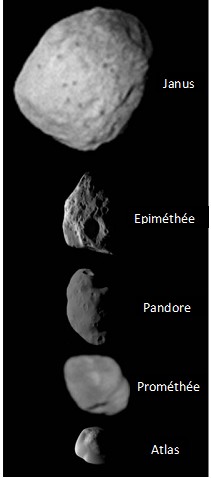 Small
satellites of Saturns (Cassini/NASA/JPL/SSI)
Small
satellites of Saturns (Cassini/NASA/JPL/SSI)
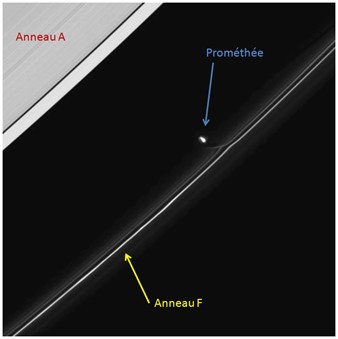 The edge of Saturn's rings , Prometheus and the F ring (images
Cassini/NASA/JPL/SSI)
The edge of Saturn's rings , Prometheus and the F ring (images
Cassini/NASA/JPL/SSI)